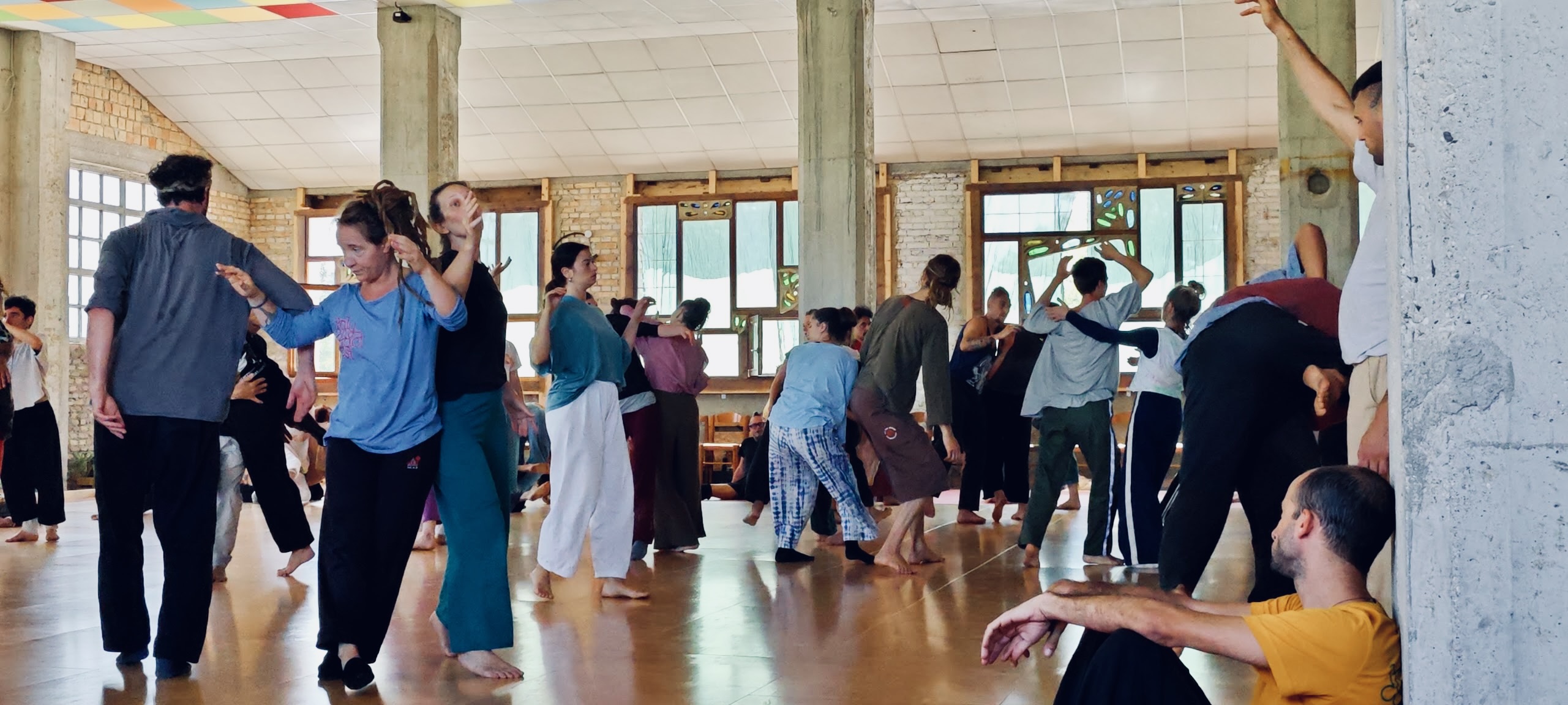
No stage, and no audience seated on one side while someone performs on the other. All it takes is a space, some music and a group of people who may not even know each other. At some point those people begin to move as a single organism, and the place around them seems to respond.
That is Risonanze (Italian for "resonances"): a participatory performance for bodies, space and music, designed to happen anywhere. Before explaining how it works, though, it is worth saying why we believe in it so much.
Why emotional intelligence starts in the body
We tend to think of emotions as something that happens in the head: thoughts, words, interpretations. Yet every emotion begins in the body. Breath that shortens, a stomach that tightens, shoulders that rise, warmth that rushes to the face. The body feels first, and only afterwards does the mind give a name to what it felt.
This is why emotional intelligence cannot be learnt just by talking about it. It is trained by inhabiting the body: noticing what is happening inside us and, at the same moment, what is happening in others. It is a relational skill before it is an individual one, and the body is where the two meet.
Risonanze is the most direct form of this training. When you move together, if you listen only to yourself you fall out of time, and if you listen only to the others you lose yourself. Attunement is born in between, and that is where emotional intelligence stops being a concept and becomes a lived experience.
"The body knows something before the mind can put it into words."
The genius loci: every place has a soul
The ancient Romans believed that every place had its own guardian spirit, the genius loci. A spring, a wood, a crossroads, a home: each had a presence to be recognised and respected. Many centuries later, the architect Christian Norberg-Schulz took up this idea to argue that places are not mere spaces, but have a character we perceive before we understand it.
Anyone who has felt it knows. There are squares that welcome and squares that push you away, courtyards that invite you to stay and streets you cross in a hurry. Every place carries an emotional memory — not the one written in history books, but the one stored in the bodies of those who have lived there: fear, waiting, joy, abandonment, belonging. You cannot see it, but you can feel it.
Risonanze exists to listen to this spirit of place and let it resonate in the bodies of the people who live there today.
Three languages, one frequency
The project weaves together three voices that happen at the same time, like frequencies that amplify one another in a resonance:
- The body: a participatory performance that turns the audience into an emotional flock. People move through the space together with the music until they become a single collective body.
- The sound: an original soundscape, created each time from the character and emotions of the place. What emerges from listening to the area and its inhabitants becomes musical material.
- The sign: a permanent visual intervention that remains in the place after the performance. A trace that says: something happened here, someone stopped here to listen.
The body happens and fades. The sound accompanies and stays in the memory. The sign remains there, visible, for whoever passes by next.
The flock: when no one leads and everyone leads
At the heart of Risonanze is an experience that is simple to describe and surprising to live. People move through the space together with the music, with no appointed leader. At some point someone hints at a direction, a gesture, a rhythm, and the others follow. Then the lead passes spontaneously to someone else, without anyone giving it away or taking it. And then to someone else again.
Then something hard to name can happen: the lead stops belonging to anyone and dissolves into a shared will. The group moves in harmony, like the flocks of starlings in autumn skies, where no bird is in charge and yet all of them know where to go.
No experience is needed. There are no steps to learn and no right or wrong movements. What matters is the condition of mutual listening that the group builds together, moment by moment. Everyone chooses how much to take part: you can watch, step in, step out, come back. No one is obliged and everyone is included.
It is precisely this free balance between individual and collective that makes the flock possible. A group that forces never becomes an organism; a group that welcomes does.
A place that becomes a community again
In many places people live side by side without ever meeting. They cross paths every day without recognising each other. Sometimes they speak different languages or carry different memories of the same spaces. Regeneration policies work on streets, buildings and services, but they rarely touch the invisible fabric that holds a community together: trust, mutual recognition, the feeling of being part of something.
That is exactly where the flock works. To move together you don't need a common language, you don't need to agree on everything or share the same history. You only need to listen to each other. In that listening, for the length of the performance, what divides people can stop mattering: newcomers and those who have always been there, young and old, people from one side and people from the other. This is true everywhere, and perhaps even more so in places that have known division, abandonment or marginality.
"Once the body has felt that it is possible to move together, that experience is never entirely forgotten."
Risonanze does not solve a place's problems, and it doesn't claim to. It offers something smaller and, I believe, more necessary: a concrete experience of community, lived through the body and within the spirit of a place.
A format that adapts to the place
Risonanze does not arrive with a ready-made show to be repeated identically everywhere. Each edition begins with a phase of listening to the place, made of encounters, stories, sounds and glances: it is how we get to know its genius loci. The soundscape and the visual sign grow from there, which is why no two Risonanze will ever be the same.
When the music fades and people disperse, the visual sign stays in the place. It is not a monument or a commemorative plaque, but a trace that keeps asking questions of whoever passes by. It is a way of giving back to the place what the place has given, and of remembering that public space can also be a space of relationship.
An appointment can remain too. Risonanze can become a ritual held every six months, a public and convivial moment of shared presence to come back to, and to see how the flock — and the place — change each time.
A community, after all, is a group of people who manage to move together without ceasing to be themselves. And every place, if we listen to it, has something to teach us about how to find each other again.
Are you a local authority, a cultural organisation, a festival, a museum or a park? We can design Risonanze together, starting from the soul of your place.
Contact us → Read also: participatory art →