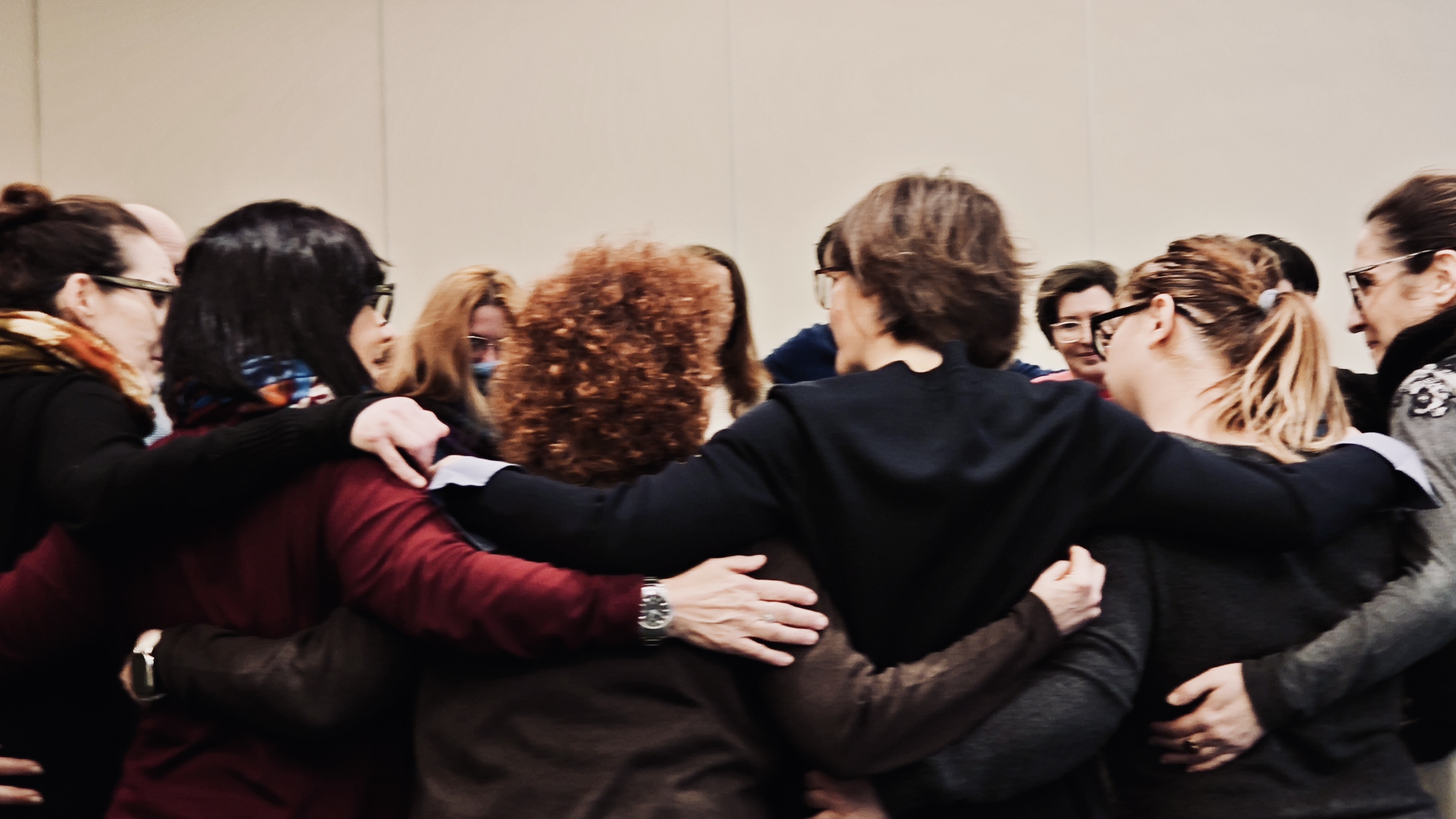
Not shows to watch: experiences to inhabit. How performance and art installations can turn an audience into a community — and aesthetics into real encounter.
There is a kind of art that is not consumed. That is not watched from a distance with arms folded. That enters the body, asks for something, changes something — even if only for a moment.
"Participatory art doesn't want an audience. It wants witnesses. Presences. People willing to be moved through by something."
From watching to taking part
For centuries art worked according to a clear model: the artist produces, the audience consumes. A physical space separates the two — the stage, the frame, the pedestal. And that separation makes sense: it protects the work, creates aesthetic distance, allows contemplation.
But from the second half of the twentieth century, something began to change. Artists such as Allan Kaprow with his Happenings, Marina Abramović with her relational performances, and Augusto Boal with his Theatre of the Oppressed all began to ask: what happens when the boundary between artist and audience dissolves? When the spectator steps into the work?
The answer: something radically different happens. An encounter happens.
What makes art truly participatory
Including the audience is not enough to make participatory art. Some forms of "participation" are really just interaction — touch this, press that, choose the ending. That is not participation: it is interactivity.
Truly participatory art has precise characteristics:
- The audience doesn't follow instructions — it co-creates meaning. Its presence, choices and emotions enter the work and change it.
- There is risk — for the artist and for the participants. Not physical risk, but relational risk: being seen, being touched by something, not knowing what will happen.
- Space becomes a relational field — not a concert hall or a museum, but an environment in which the usual rules of social interaction are suspended or renegotiated.
- The time of the experience is irreversible — it cannot be rewound, rewatched or reloaded. It exists only in the moment it happens.
Art as an emotional intelligence device
Why does EI YOU! work with participatory art? Because it is one of the most powerful devices we know for bringing people into contact with their inner lives — and with those of others.
An installation that asks you to stop and feel. A performance that creates a moment of shared presence. A lab where something is built together with physical materials — not slides, not sticky notes. These contexts produce something that rarely happens in traditional training: authentic contact.
Not a simulation of contact. Contact itself.
EI YOU! experiences in cultural and festival settings
EI YOU! aims to bring its artistic devices to cultural festivals, public spaces, corporate events and community settings. Every installation or performance is designed in relation to its specific context: the place, the audience, the purpose of the event.
- Participatory installations — immersive environments in which visitors are invited to interact with questions, materials and spaces. They are not decorations but relational devices that spark reflection and contact.
- Emotional intelligence performances — staged moments that cross the line between stage and audience. They use the body, the voice, silence and physical proximity to create experiences that stay with you.
- Creative labs at festivals — hands-on spaces open to everyone, with no selection, where we work with the body and relationships to explore themes such as belonging, care, boundaries and contact.
Why aesthetics is not separate from emotion
There is a widespread prejudice: that art is for the few, that beauty is a luxury, that aesthetics is separate from everyday life. EI YOU! starts from the opposite premise: aesthetic experience is a fundamental form of emotional intelligence.
When we are touched by something beautiful — or unsettling, or true — our emotional system switches on. We enter a state of greater openness and receptivity. Our defences drop. We become more able to feel, and therefore to connect — with ourselves and with others.
Art is not an ornament of life. It is one of the oldest tools humanity has for recognising itself, for meeting, for giving shape to the unspeakable.
Looking for an artistic format for your festival, event or public space? Let's design it together.
Contact us → Read also: Risonanze →